

Here are the four most powerful tools for long-term learning
/ Pooja K. AgarwalThis week, we feature a roundup of the four most powerful tools to boost students' long-term learning, backed by cognitive science research: retrieval practice, spacing, interleaving, and feedback-driven metacognition.
How do you use these four strategies? Share with us on Twitter and Facebook!
Four Power Tools for Powerful Learning
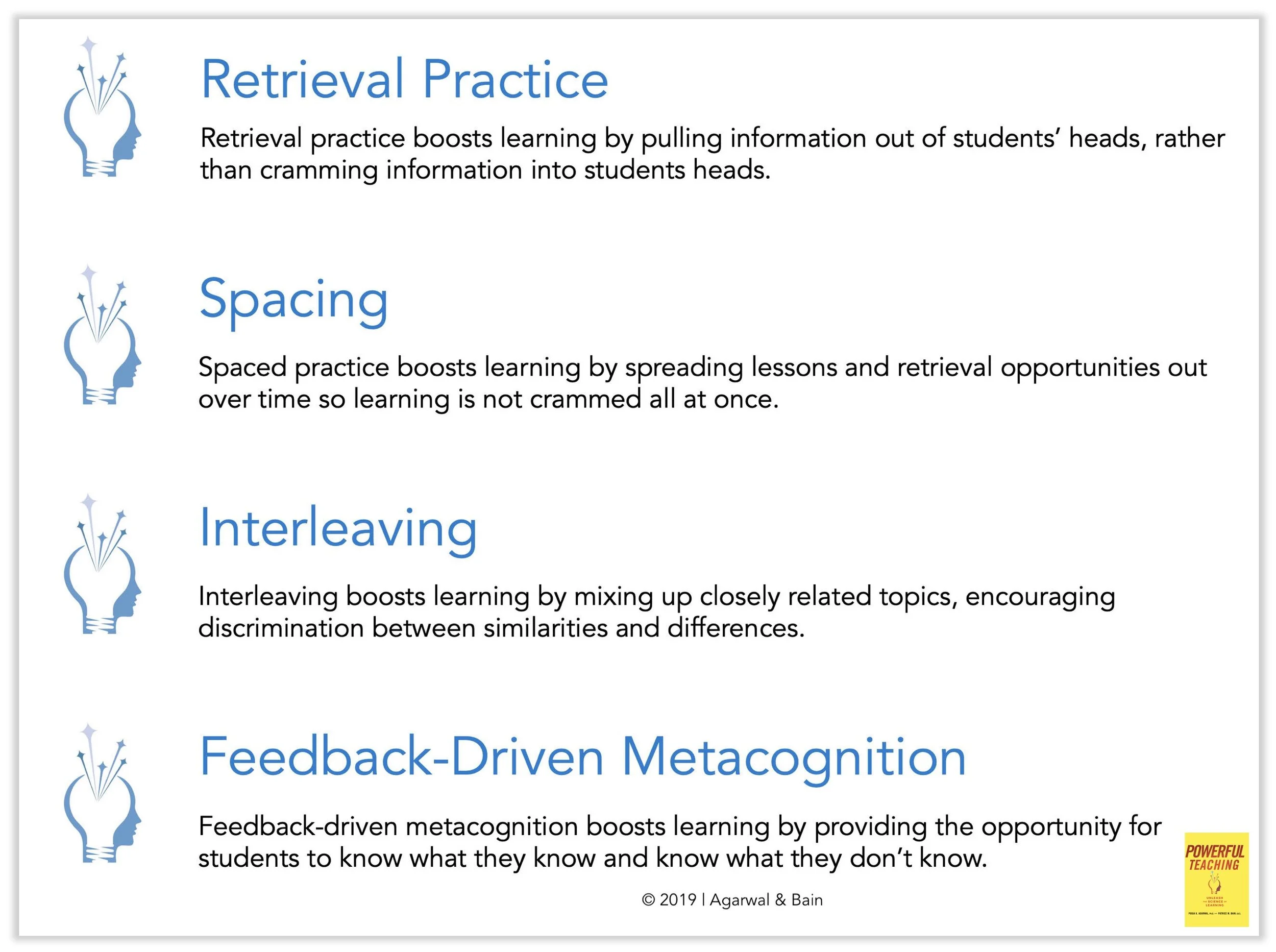
In Powerful Teaching, we highlight four Power Tools that make a big impact on students' long-term learning, even raising grades from a C to an A. Here are the four Power Tools, with our four favorite teaching strategies for each:
Retrieval Practice: Get information out of students' heads, not in
Download our Retrieval Practice Guide

Do you use study guides in your classroom, where key information is in outline form and students fill in the blanks during a lesson? Turn your study guides into Retrieval Guides without additional prep, grading, or class time! Download our Retrieval Guide Template for successful long-term learning.

Are students actually retaining what they're trying to learn while studying? Not always. Rather than note taking, have students engage in what I call Retrieve-Taking.

With the end of the semester within sight, we feature a small strategy that makes a big impact on student learning – based on decades of cognitive science research. In scientific lingo, we call it "free recall."
Spacing: Spacing learning over time; don't cram it all at once
Download our Spacing Guide

Did you read about our end-of-semester activity from last week, Flash Forward? This week, we have two strategies to add onto Flash Forward – by readers like you!

In this retrieval activity called Flash Forward, ask your students: “What do you want to remember 10 years from now?”. This is a critical question – one that you and your students need to ponder.

How can we help students build connections beyond the classroom? It can be hard. Really hard. Don't despair! This week, we feature Connection Notebooks, a quick evidence-based strategy by teaching expert and collaborator James M. Lang. They're the perfect opportunity to boost students' transfer of knowledge and extend learning from the classroom to the world beyond.

Are cumulative exams the same thing as spacing or interleaving? Actually, not quite. Cumulative exams can be beneficial for learning. But there are also some subtle ways we can take cumulative exams to the next level – by ensuring that we (and our students) are using spacing and interleaving throughout the semester, not just before the exam.
Interleaving: Mix up related information to foster discrimination
Download our Interleaving Guide

What is the optimal timing for retrieval practice? The answer—from the world’s expert on spaced retrieval practice, Dr. Shana Carpenter—may surprise you. Learn about spacing (aka spaced repetition), Dr. Carpenter’s research, and how to incorporate spacing in your teaching.

Get tips from cognitive scientist Dr. Veronica Yan, the world’s leading expert on interleaving. Boost student learning by mixing up concepts: problem sets, vocabulary words, different types of storytelling structures, etc. It’s a small adjustment that makes a big difference.

Are you learning to play an instrument? "Practice makes perfect," right? There's a catch: Just because you're practicing an instrument, a language, or even CPR resuscitation, it doesn't mean you're learning. What can you do? Use interleaving! Download our interleaving guide and read tips from an orchestra director. Boost learning and mix it up!
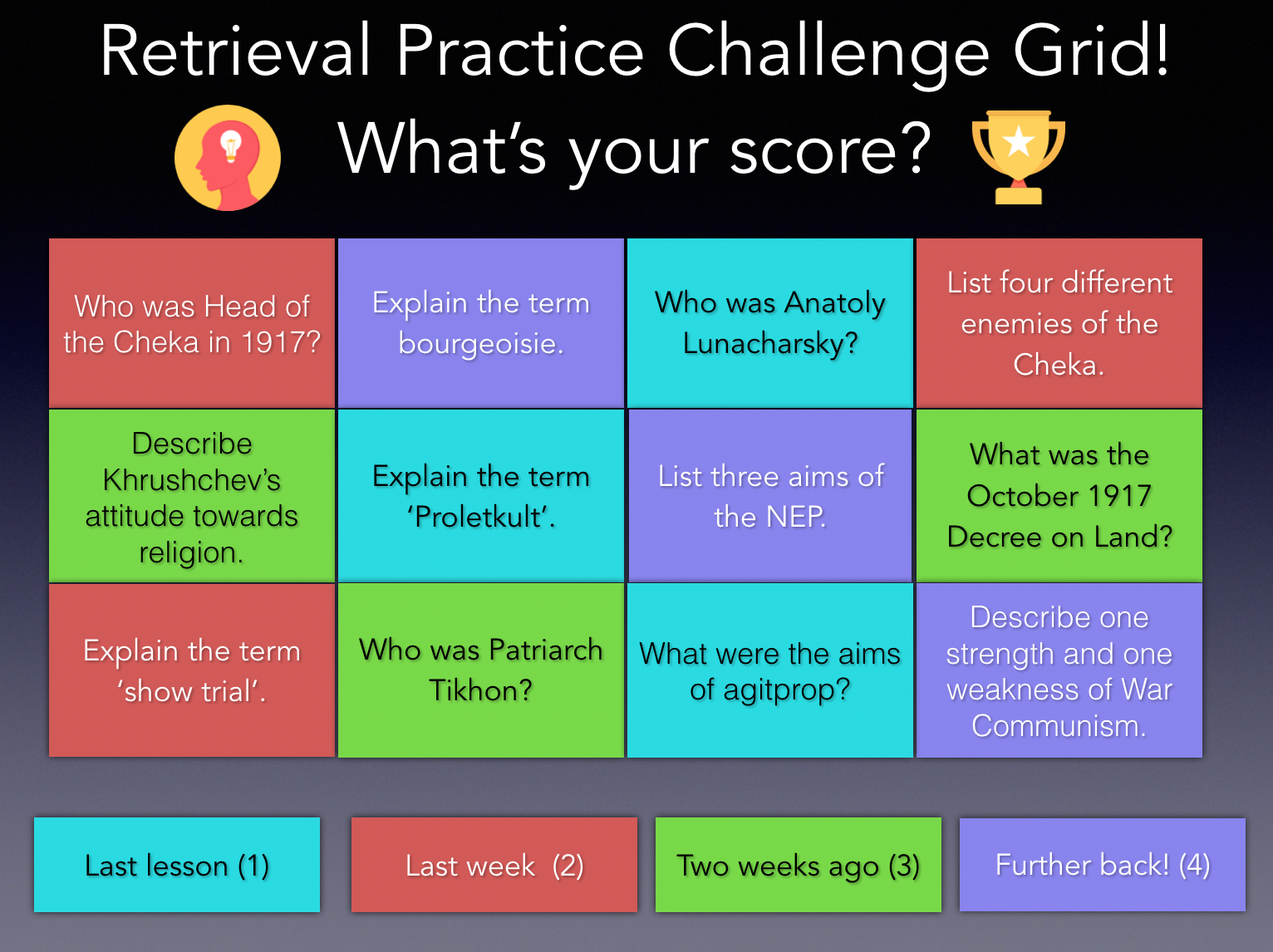
Resources are good. Templates are great! Check out Retrieval Grids, a flexible template you can download and create using low-stakes retrieval, spacing, interleaving, and feedback. Retrieval Grids aren't just for any classroom; adapt them for YOUR classroom!
Feedback & Metacognition: Help students reflect on what they know and what they don't know
Download our Transfer Guide (Metacognition Guide coming soon!)
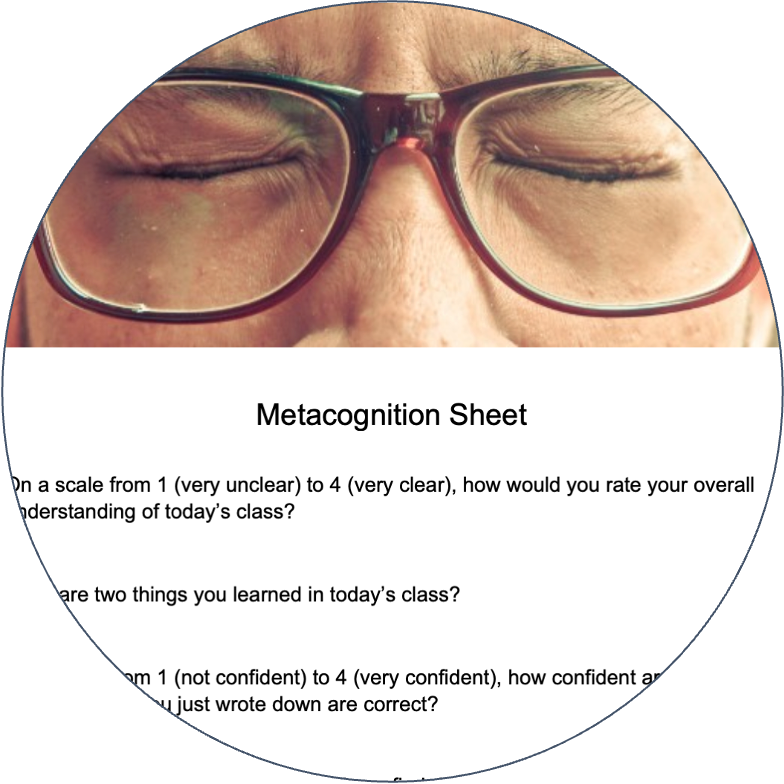
We know research can be intimidating. Read my Research Snapshot, a quick rundown of one powerful strategy and the research to back it up: Metacognition Sheets. I’ve removed the jargon, replaced it with key takeaways, and added a new download, too.

Check out a new strategy: Metacognition Line Up. Get students moving, retrieving, and reflecting, regardless of grade level or content area. Metacognition Line Up moves quickly and can be completed in less than five minutes per round!

We know feedback is good for learning. But what's best? In our new guide on students' application and transfer of knowledge, we also feature research-based recommendations on feedback strategies. Why? Because transfer is most successful when retrieval practice is followed by feedback. Read more for our quick no-grading feedback strategies.

Whether you teach at an elementary school or a medical school, you've probably heard of the instructional strategy, think-pair-share. Don’t skip the “think” step! Read on for research-based tips on incorporating retrieval, spacing, and interleaving to make think-pair-share an even more powerful strategy in your classroom.
Supported by a wealth of research and featured in the book Make it Stick, these strategies don't require more prep or grading (because no one wants more of that, right?). We write about each of these strategies every week, but we thought it's long overdue to summarize all four Power Tools in one update.
Want even more about the four Power Tools? Check out these summaries from Cult of Pedagogy and Edutopia.
In case you missed it, download our free professional development slides and click here for more free resources from Powerful Teaching. Have you found Powerful Teaching helpful in your classroom? Help us share the science of learning with a quick review on Amazon. We really appreciate your support.
Want to access info about each Power Tool quickly? We have direct links:
Download Our Free Guides!
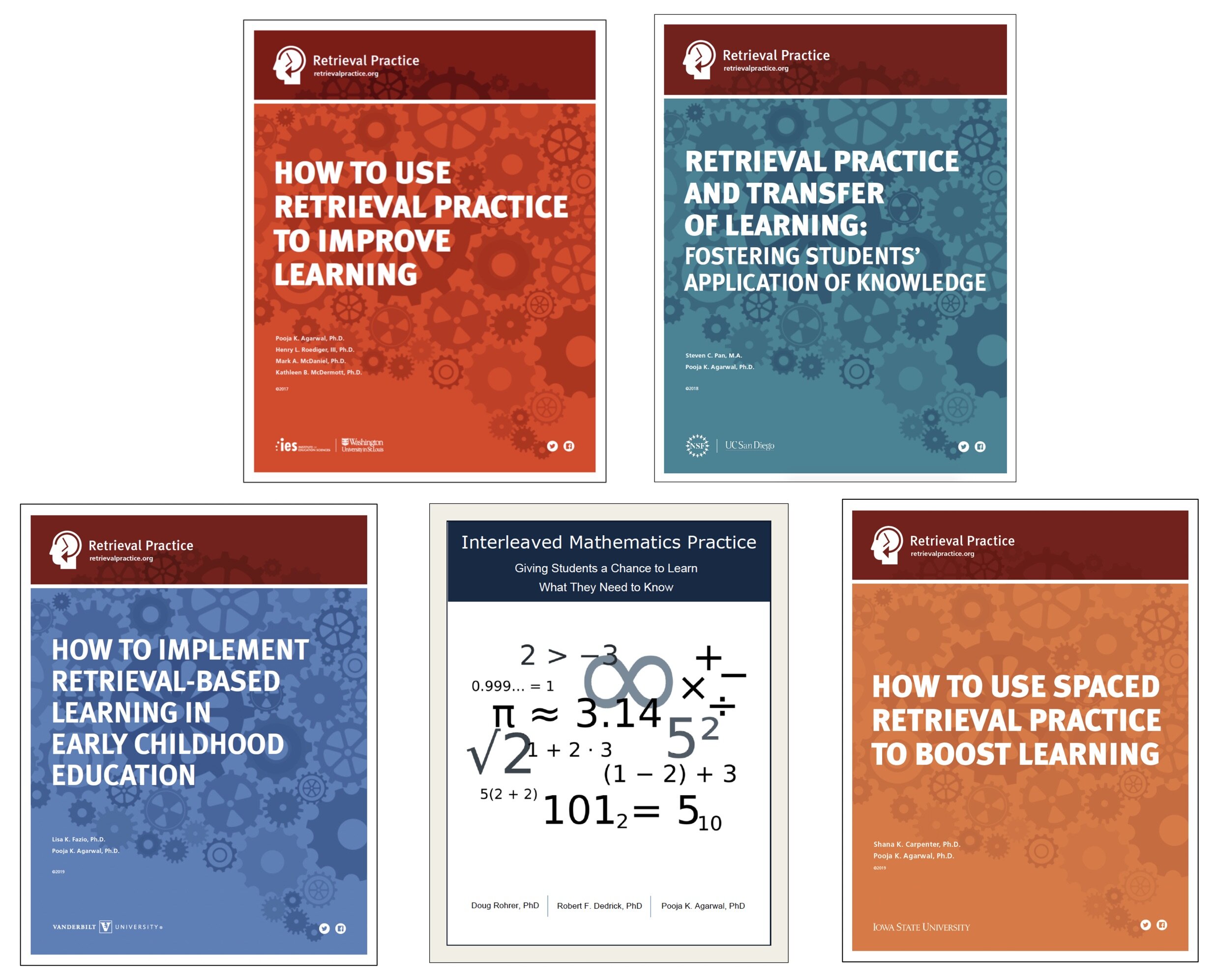
We have FREE practice guides for download. All written by cognitive scientists, 10 pages or less, including practical teaching strategies and links to research. All Creative Commons access, too. Share them, please!
Our 5 guides: Retrieval Practice, Spacing, Interleaving, Transfer of Knowledge, and Early Childhood Education. We have a guide on feedback/metacognition on the way and even more in the works. Is there a guide you'd like to see by leading cognitive scientists? Reply and let us know.
Help us reach educators around the world and share our Retrieval Practice guide translations in Spanish, Portuguese, and Mandarin (more on the way, too!).

Does retrieval practice improve learning for neurodiverse learners? Yes! Learn about the newest research, including students with developmental language disorders, Down syndrome, dyslexia, and ADHD.

Download and share our list of recommended citations on the science of learning. Increase citation rates for diverse scientists, update your citations with the newest research on retrieval practice, and demonstrate your commitment to equity and inclusion in STEM fields.

We know that retrieval practice improves learning. But does it improve learning in your classroom? It’s important to find out! Learn how to decide on a research topic, how to create data tools, and how to reach out to scientists.

Have you heard of the "testing effect" or "test-enhanced learning?" Let's clarify: Retrieval practice is not the same thing as testing; it's the opposite. When you're talking about retrieval practice, stop using the word "test."

Here's a list of 40 cognitive scientists you need to know. They publish the newest research on retrieval practice, actively engage in science communication with educators on Twitter, and demonstrate diversity beyond the traditional ivory tower. Follow them, cite them, interview them, and reach out to them.

Want a quick way to access classroom research on retrieval practice? Download our database of 50 experiments and read a detailed literature review by cognitive scientists.

"Give science away." This is what a cognitive scientist told me more than a decade ago and this is exactly why retrievalpractice.org exists. But science isn't always accessible. What can you do? Read our quick tip to access research. The science of learning has been under lock and key. Until now.

We love the science of learning. It's fascinating to think about and critical in the classroom. But what exactly does the "science of learning" really mean? Read on for the inside scoop!

Chances are you're familiar with Bloom's Taxonomy, the famous triangle diagram. But do we have to build students’ fact knowledge before engaging them in higher order learning? Or is it the other way around? According to new research, students can reach the top of Bloom's Taxonomy without starting at the bottom.

Do you enjoy putting research into action and staying on top of cutting edge research? Don't despair. You can access science straight from the source – it just takes a little know-how. Read on for our top 5 tips for finding, accessing, and reading bona fide research from the science of learning!

When we write about research and the science of learning, we usually write about learning in K-12. But retrieval practice, spacing, interleaving, and feedback are powerful in college (and beyond), too. Read and share our second Research Snapshot on research-based strategies in college STEM courses. Spoiler alert: They dramatically boost learning!

When we talk about retrieval practice, here's one question that frequently pops up: Does retrieval practice with multiple-choice questions boost learning? Here's the quick answer, based on cognitive science research: Yes! Read on for research, recommendations, and this week's multiple-choice retrieval practice.


Lots of students use flashcards. But using flashcards doesn't guarantee they're using retrieval practice. In fact, students could be wasting their time. This week, we share three research-based tips to make flashcards more powerful. Help students study smarter, not harder.