

Before starting group work, do this first
/By Pooja K. Agarwal, Ph.D.
‘Tis the season for group work! We’ve all been there: some students struggle to get started, one student dominates the conversation, and the rest wait for others to do the heavy lifting.
Here’s an easy solution: retrieval practice. I typically think of retrieval practice as a strategy to boost long-term learning, but retrieval practice is a valuable tool to engage students in thinking and learning before collaborating in groups, too. Continue reading for how to incorporate it into group work, with examples from my own classroom.
And it’s the one-year anniversary of my second book, Smart Teaching Stronger Learning. Click here to download a summary of the book, and keep reading to find out how to receive 30% off the book list price and free professional development with me.
As always, reach out to me at ask@retrievalpractice.org with your ideas, questions, and success stories. Hearing from individual readers is truly the highlight of my day (plus teaching 😄).
P.S. We’re nearing the 7th anniversary of my first book, Powerful Teaching!
Let’s celebrate!
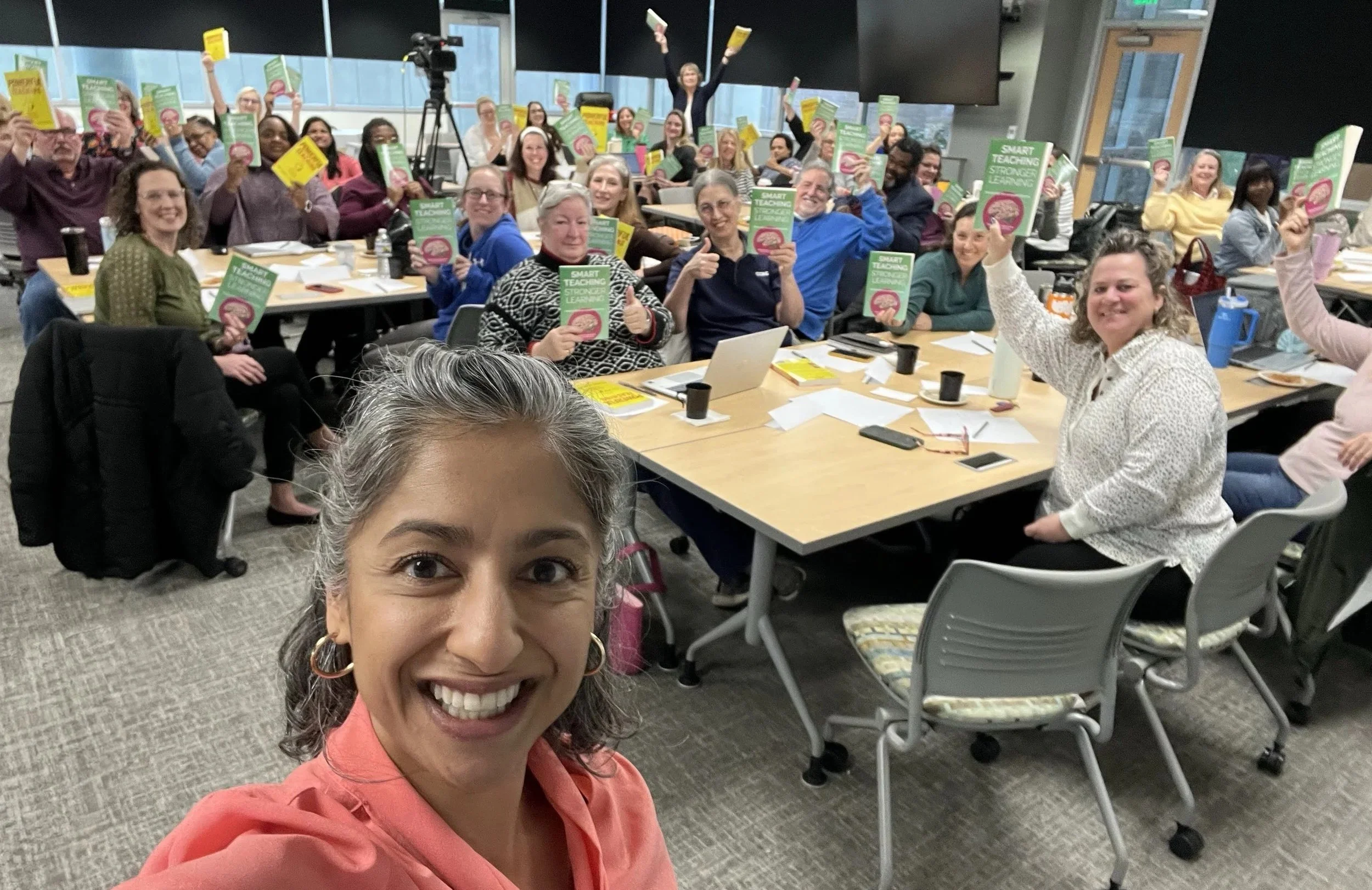
When I started putting together Smart Teaching Stronger Learning, I was excited to bring together a team of cognitive scientists—who are also teachers—to share research-based tips from their own classrooms. I honestly didn’t imagine how much of a hit the book would become.
Thousands of educators around the world have been reaching out with their success stories from nearly every single continent (we’re still waiting to hear from Antarctica). We received a very kind email from an educator in Kazakhstan; we’ve had teachers from New Zealand, Poland, and India join live on our Zooms; and more than 1,000 school leaders throughout the state of California received our book. From facilitating small workshops (above is a selfie with educators from the Community College of Baltimore County) to keynoting at large conferences, it’s an honor to meet educators who are making an impact with the science of learning. (Click here to download free resources and watch our book launch from last year.)
If you would like Smart Teaching for your PLC, FLC, new faculty orientation, book club, department, or school, receive 30% off the list price when you purchase 50 or more books. At only $13/book, Smart Teaching is an affordable, accessible introduction or refresher for you and your faculty on the science of learning. It’s short: 10 chapters, 10 pages each, with practical teaching tips from experts. As one educator shared on Amazon, “I purchased this book for all my faculty. They have all had positive things to say about the recommendations in the book. I have yet to read the book because I keep loaning it out to new faculty. I need to get my own copy.” 😅
In addition to 30% off when ordering at least 50 books, receive a complimentary private Zoom with me for larger bulk orders:
100 books includes a 30-minute “ask me anything”
175 books includes a 1-hour “ask me anything”
300 books includes a 1-hour interactive keynote
All in-person speaking engagements include complimentary copies of Smart Teaching. Email me at ask@retrievalpractice.org to get started with a bulk order.
How to use retrieval practice before group work

Photo credit: Mimi Thian via Unsplash
Usually, I share how to implement retrieval practice with a brain dump, as the first step in think-pair-share, or as an entry or exit ticket.
But retrieval practice is an effective tool for group work, too. Here’s how you can enrich group work with retrieval practice before groups get together:
Take your time thinking about what students will be working on during group time. For example, will they be completing a worksheet? Answering specific discussion questions? Preparing for a presentation? If you’ve been doing group projects for a long time, breaking this down might be harder than you expect.
Take a step back and zoom out to the bigger picture. Ask yourself: how can students do that work individually? For example, they could complete part or all of the worksheet on their own, write out thoughts to discussion questions beforehand, or brain dump what they plan to share during their portion of a presentation. This is the key step where retrieval practice happens before group work.
Give students time to retrieve individually. This can feel awkward. Remind yourself and your students that during retrieval practice, silence is golden. Yes, this takes class time, but it’ll also save you time later (see step 5).
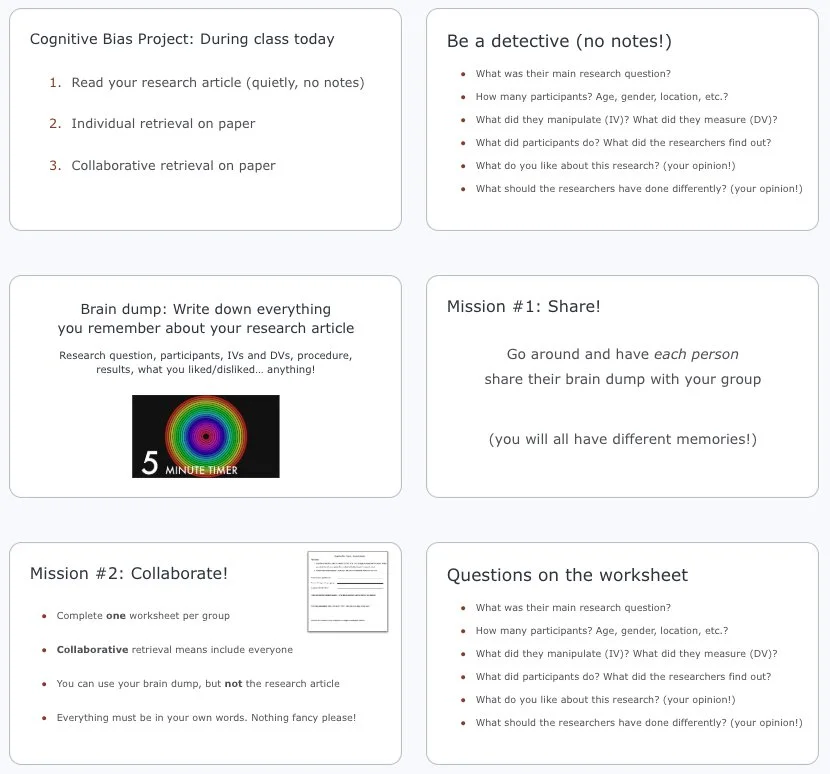
Give groups a “mission” to have each student share their retrieval before discussion. There is no leader, notetaker, or roles. Everyone is participating equally. If your students are used to jumping straight into group work, they may skip this step! I recommend displaying the mission instructions on the projector to keep them on track.
After each student has shared, now they start their group work. Now, the collective group has richer ideas—and literally more ideas—than they would have had without individual retrieval practice. Plus, because students already generated their ideas in advance, the group work will actually go faster than usual.
Here’s a screenshot of my slides from my Cognitive Psychology course, where students read a research article independently, do a brain dump on a half sheet of paper, and then share before group work:
Here’s how to add retrieval practice to group presentations, too.
As my colleague, cognitive scientist-teacher Dr. Janell Blunt says, “Anything students do from memory is retrieval practice.” And it doesn’t have to be after instruction; make retrieval practice part of your instruction. With this retrieval approach to group work, each student takes ownership for their own learning, retrieving, thinking, sharing, and contributions.








What is the optimal timing for retrieval practice? The answer—from the world’s expert on spaced retrieval practice, Dr. Shana Carpenter—may surprise you. Learn about spacing (aka spaced repetition), Dr. Carpenter’s research, and how to incorporate spacing in your teaching.