

How to be intentional with the science of learning
/Recently, I’ve had the pleasure of auditing two courses at my college: The History of the American Music Industry and Introduction to Computer Programming. Both courses focus on topics that are brand new for me, and often my head is swimming with ideas and concepts by the end of class.
I’m also learning a lot from my friends’ approaches to teaching, especially how to use retrieval practice with intention. You’re probably using retrieval practice already, but keep reading for tips on how to be even more intentional when you teach and share the science of learning.
Speaking of being intentional, have you registered for my free webinar series yet? My next webinar on effective student study strategies is on Wednesday, October 14 at 5pm ET. The Zooms will be recorded, but you must register to access the recordings.
Intention today. Retention tomorrow.
In the music history course I took this summer, the professor (hi, Kate!) used think-pair-share with discussion questions to support students’ transfer of learning. For example, following her lecture on the 1970s TV show Soul Train, Kate asked students to identify similarities and differences between Soul Train and dance influencers on TikTok.
In cognitive science research, we refer to this as “far transfer.” Rather than having students examine music from different Soul Train episodes (“near transfer”), Kate extended students’ learning of the history of Soul Train to their modern familiarity with Tiktok. This might seem like a far stretch, but it’s precisely this type of question—applying learning from one situation to a completely new situation—that takes retrieval practice beyond memorization. (Click here to download my Practice Guide PDF on transfer of learning.)


As another example, n the intro to programming course I’m taking this fall, the professor (hi, Sam!) incorporates retrieval practice using an entry ticket as students arrive to class each week. Students login to Canvas (our LMS) and retrieve a few things they remember from the previous class meeting. Importantly, each entry ticket includes an example of a response that would receive 0 points in contrast to a detailed example that would receive full points. Sam’s entry ticket is time efficient (during the first 5 minutes of class as students get settled), low-stakes (worth 1 point), practical (easy to mark as completed in our LMS), and flexible based on recent course content to reduce students’ use of AI.
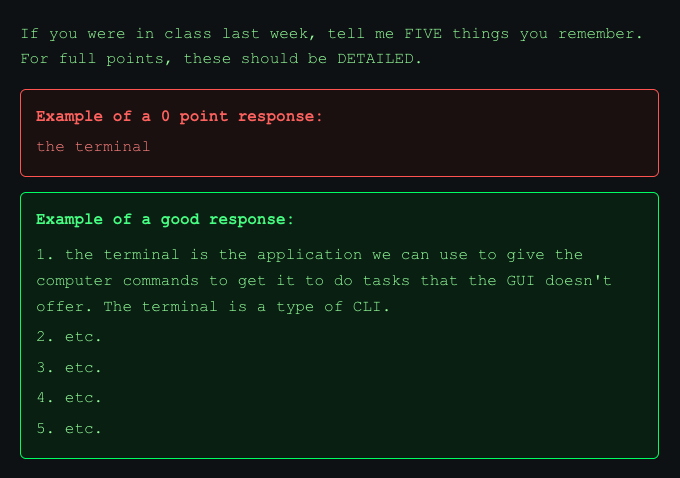
One more thing stood out to me in both classes: Kate and Sam intentionally explain to students why they are using transfer questions and entry tickets. I realized I need to do this more often! While I discuss the importance of retrieval practice with my students on the first day of class and we engage in retrieval throughout the semester, I’m going to explain my intentions more clearly going forward. As a simple example, in addition to my typical lead in, “Let’s pause and retrieve two things,” I’m going to add, “Because this will improve your long-term learning and that’s important to me.”
My colleague Dr. Michelle Rivers published an excellent literature review in Educational Psychology Review on how direct instruction about the benefits of retrieval practice can improve students’ study habits. (I’ll share more about effective study tips during my upcoming webinar on October 14.) A key takeaway is to do both: engage students in retrieval practice (you’re probably already doing this) and explain why you’re using retrieval practice (aim to be more intentional).
I recently received an email about the importance of intention from an educator in South Dakota, Sally Flemming. (I love emails from readers! Don’t hesitate to email me at ask@retrievalpractice.org). Sally shared the following:
“What began as four simple math questions each day eventually developed into a system; I now call Intentional Math Practice. The results surprised even me. Our state math proficiency had been around 35%, and after changing the way students practiced, we saw dramatic growth—including over 70% proficiency among students who were with me for the full year. But what excited me even more was seeing students remember more, need less reteaching, and become much more confident mathematicians.”
And I love this phrase from Sally’s email: “Intention today. Retention tomorrow.” I’ll be keeping this in mind throughout the school year and I hope you will, too.
Be intentional with retrieval practice:
Create discussion questions that support students’ transfer of learning
Build class routines with entry and/or exit tickets for spaced retrieval practice
Explain to students why you are using retrieval activities to improve their metacognition and understanding of the learning process
Share cognitive science with intention

Photo credit: Helena Lopes via Unsplash
Whether it’s for your blog, podcast, book club, professional development event, PLC, and/or social media, the research you choose to share matters. If you’re making the time to share the science of learning, make the time to be intentional about the research you are sharing, too.
Ask yourself the “five WH questions”:
Who is your intended audience? Are they primarily interested in cognitive science research, teaching strategies, or both?
What do you want to accomplish by sharing the science of learning? To inspire, empower, or inform?
When was the research published? Do today’s classrooms look similar to or different from the year in which the research was published?
Why are you citing research in the first place? Is it to persuade your audience? To add a sense of scholarly investigation? To provide an additional source of information?
How are you choosing the research you want to feature? Have you already featured it before? Does it directly back up the point you are trying to make?
For example, if you’re writing an article for the general public about cognitive science, you could cite laboratory research as a foundation for how scientists study learning. Laboratory research in well-controlled environments (college students as participants) with well-controlled materials (like simple vocabulary words or facts) helps us get at the theoretical “root” of how learning and memory work.
If, however, you’re sharing specific teaching strategies or activities based on cognitive science, feature and cite classroom research as supporting evidence that the strategies you are recommending improve learning in the real world with a range of student abilities and classroom materials.
Earlier this week, my colleague and friend Dr. Ludmila Nunes and I were discussing this distinction: When should you cite laboratory research and when should you cite classroom research? When should you cite historical research and when should you cite new research? All approaches to research are integral for advancing cognitive science (I’ve published both laboratory research and classroom research) and we agreed that there’s no “right” way to choose, except that it’s critical to be intentional about the choices you are making.
Interest in applying cognitive science in the classroom has dramatically increased in the past 20 years, and so has research on learning (click here for my recent publication on this point). So, how can you keep up to make informed choices? Here are the resources I’ve created to make it easier for you to cite classroom research, access the newest research, and diversify your citations.
Do you want to share classroom research about specific teaching recommendations based on grade level and content area? Click here to download my sortable spreadsheet of 50 classroom experiments on retrieval practice.
Do you want to share the newest research in cognitive science? Click here to download my list of 20 articles published since 2010 and learn why 2010 was a key turning point in cognitive science research.
Do you want to share laboratory research? Click here to download my list of 10 recommended research articles and literature reviews.
Do you want to geek out about research even more? Create a Google Scholar alert, read my research snapshots, and learn more about today’s leaders in cognitive science research.
Register for my upcoming webinars

Join me for my FREE webinar series on Zoom this fall. Nearly 900 educators from around the world have registered. Don’t miss out! In my webinar last week, I shared tips for getting students excited about the science of learning. Here are my upcoming webinars:
Wednesday, October 14 at 5:00pm ET: How to help students study smarter (not harder) with research-based study strategies
Tuesday, November 17 at 12:00pm ET: Why forgetting is normal, why it’s good for learning, and how to normalize it in your classroom
Thursday, December 10 at 10:00am ET: How the brain actually works, why we fall for neuromyths, and how to be an informed consumer of neuroscience research









GenAI tools in education have been gaining momentum for years, but I’ve written about AI only once so far. Why? Because frankly, I’m tired of thinking about it. Here’s my current approach to genAI in my classroom, and my two recommendations for what to do if you’re tired, too.