

Flip the Script: What will you *forget* and why?
/By Pooja K. Agarwal, Ph.D. (@RetrieveLearn)
Recently, I shared my What-and-Why strategy for retrieval practice. The gist: You already ask students what they remember. Next time, ask them why they remember it.
Here’s a twist on What-and-Why with a follow-up strategy I call Flip the Script: Ask your students what topics they’re likely to forget and why. It might seem counterintuitive, but asking students about forgetting increases learning. Keep reading for my tips and the research behind Flip the Script.
Curious for more? My next free webinar—all about forgetting—is on Tuesday, November 17 at 12:00pm ET. Click here to register and receive the Zoom recordings.
Help spread the word, please! If you have a newsletter for faculty, you’re at a teaching center, you have a blog, or you’re active on social media, click here for a short announcement about my webinars that you can copy, paste, and share.
Flip the Script: What are you going to forget?

Photo credit: Vitaly Gariev via Unsplash
I talk with my students about the importance of long-term learning, of course, but I also always share how much I’ve forgotten from my own college education. My students are surprised when I mention this. Why? I’ve found that teachers (and students) rarely talk about forgetting. This might be because it can feel embarrassing, but as I remind my students, forgetting is normal, too.
Here are strategies I’ve written about previously that you can use to get students talking about learning:
Ask three important questions: How do you study? Why do you study that way? And does it work?
Flash Forward: What do you want to remember 10 years from now? Why?
What-and-Why: What is something you remember about this topic? Why do you remember it?
All of these questions ask students about learning, but an underlying theme is forgetting. With Flip the Script, switch from talking about learning to intentionally talking about forgetting:
What is something about this topic that you’re going to forget?
Why are you going to forget it?
Be prepared—this could feel awkward at first! Your students might feel shy admitting they’re going to forget what you’re teaching them. Remind them that you (the teacher) also forget what you’re learning, forgetting is normal, and retrieval practice can be challenging. That’s precisely the point: when engaging students in the desirable difficulty of retrieval, they’ll also need to become comfortable with forgetting.
If asking students to predict what they might forget feels nerve wracking for you (trust me, I get it), then consider an additional Flip the Script activity:
Have students engage in a brain dump or retrieving two things individually (this is the critical think step in think-pair-share)
Have students pair and share what they retrieved. Ask them: Why was that information memorable?
Flip the Script: Have students pair and share what they forgot. It’s likely that students retrieved different concepts and forgot different concepts. What did they forget? Why did they forget?
Flip the Script relates to cognitive psychology research on what we call “judgments of learning” (JOLs). When students are asked to reflect on their learning (known as metacognition), research demonstrates that metacognitive questions improve students’ long-term learning beyond retrieval practice (click here to download my Metacognition Practice Guide, co-written with cognitive scientist Dr. Lisa Son).
There are many types of ways researchers ask for students’ JOLs (click here to download a literature review about JOLs by cognitive scientist Dr. Michelle Rivers), though typically researchers ask students to predict how likely they are to remember information they’re learning. In a recent laboratory study (free/open access), asking students to make “judgments of forgetting” enhanced their memory as much as asking for a more typical prediction of learning.
If you’d like to learn more about forgetting, join me for my free webinar on November 17. I’ll be sharing additional teaching activities, tips for conversations with students, and slightly embarrassing stories of my own forgetting.
Learn about forgetting on November 17

Join me for my FREE webinar series on Zoom this fall. If you’d like to receive the recordings, make sure you register in advance.
Tuesday, November 17 at 12:00pm ET: Why forgetting is normal, why it’s good for learning, and how to normalize it in your classroom
Thursday, December 10 at 10:00am ET: How the brain actually works, why we fall for neuromyths, and how to be an informed consumer of neuroscience research
Help me spread the word about my webinars! If you have a newsletter for faculty, you’re a teaching center, you have a blog, or you’re active on social media, click here for a short announcement you can copy, paste, and share.
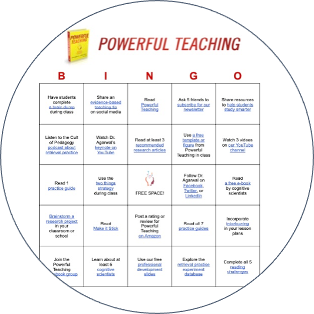








I’m really proud of the online library I’ve built over the past 10 years. Click here to download my 100+ free resources directly from Google Drive. If you don’t know where to start (it’s a lot), keep reading for an overview of everything you’ll find in my library.