Join Dr. Agarwal's virtual office hours on Friday, April 8, 2022
/ Pooja K. AgarwalChat with Dr. Agarwal during her office hours on Zoom Friday, April 8, 2022 between 5:00pm - 6:30pm EDT (eastern time)!
Office Hours with Dr. Agarwal
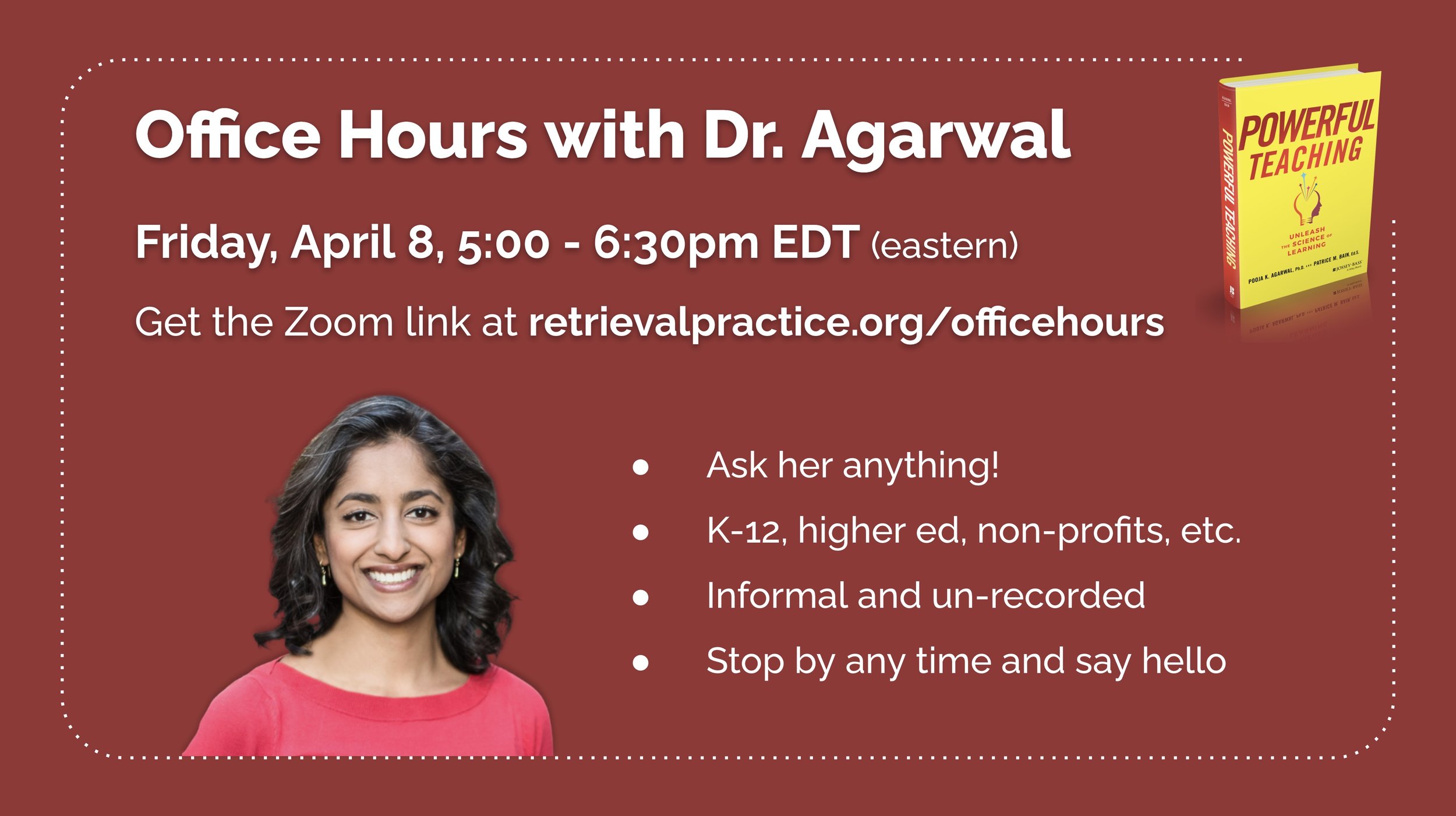
On Friday, April 8, 2022 from 5:00pm - 6:30pm EDT (eastern time zone), join cognitive scientist Dr. Pooja K. Agarwal for her office hours on Zoom.
Ask her anything! Learn more about retrieval practice, Powerful Teaching, the science of learning, free resources, etc.
Everyone is welcome: K-12, higher ed, non-profits, etc.
Join the informal, un-recorded conversation
Stop by any time, for as long as you like or just to say hello
ICYMI: 5 new resources and downloads

Photo by gratisography
We've been working hard behind the scenes to bring you 5 new resources:
Powerful Teaching updates, including a Parent's Guide, a Spanish translation, free templates, and a Facebook group with 2,000 teachers
Practice guides by cognitive scientists, including our new guide on effect sizes (ever wondered what John Hattie's effect sizes really are?)
Free slides for your professional development (yes, please use them!)
A downloadable database of retrieval practice research in authentic classrooms, with a recently published literature review
A new FAQ as a quick reference for all things retrieval practice

Have you finished teaching a course, but didn’t take notes about how it went after each lesson? It’s not too late for some quick retrieval practice! Continue reading for quick lesson reflection questions to ask yourself before you forget. Your future self will thank you.
Here’s an easy solution for stale group work: retrieval practice. In addition to boosting learning, it is a valuable tool to engage students in thinking and learning before collaborating, too. Learn how to incorporate it into group work, with examples from my own classroom.
If your students use concept mapping strategies, there might be something missing. Based on research by educator and scientist Dr. Kripa Sundar, the key to an effective concept map isn’t the node, but the links.
Use a structured “ask me anything” (AMA) activity to encourage retrieval practice and community building. Here's how to do it in your classes, for any grade level or class size, including no-tech and ed tech options.
What is the optimal timing for retrieval practice? The answer—from the world’s expert on spaced retrieval practice, Dr. Shana Carpenter—may surprise you. Learn about spacing (aka spaced repetition), Dr. Carpenter’s research, and how to incorporate spacing in your teaching.
Welcome back to school! The whirlwind of lesson prep, meetings, professional development—and of course, teaching—is here. Here are my favorite back-to-school activities to engage students with retrieval practice during the first week of class.
Ready to strengthen your students' long-term learning? Gain practical tips from cognitive scientists who are also teachers! Join us for an interactive workshop with five renowned learning experts sharing innovative teaching strategies they use in their own classrooms.
Get tips from cognitive scientist Dr. Veronica Yan, the world’s leading expert on interleaving. Boost student learning by mixing up concepts: problem sets, vocabulary words, different types of storytelling structures, etc. It’s a small adjustment that makes a big difference.
Read about these simple, bite-sized strategies from Dr. Michelle Rivers to use what you’re already doing in the classroom and boost student learning even more. Dr. Rivers’s strategies take little or no prep, no extra grading, and very little time to implement, including questions du jour and name tents.
There are two red flags I always watch out for at conferences, and you should, too: Outdated citations and neuromyths. Replace cringeworthy citations with my list of recent research and get tips on how to spot neuromyths from cognitive scientist Dr. Roberta Ekuni.
White boards for retrieval practice are engaging and effective for learning, providing flexibility for question prompts and student responses. Read tips by cognitive scientist Dr. Janell Blunt and make this a no-prep strategy for your classroom.

GenAI tools in education have been gaining momentum for years, but I’ve written about AI only once so far. Why? Because frankly, I’m tired of thinking about it. Here’s my current approach to genAI in my classroom, and my two recommendations for what to do if you’re tired, too.