
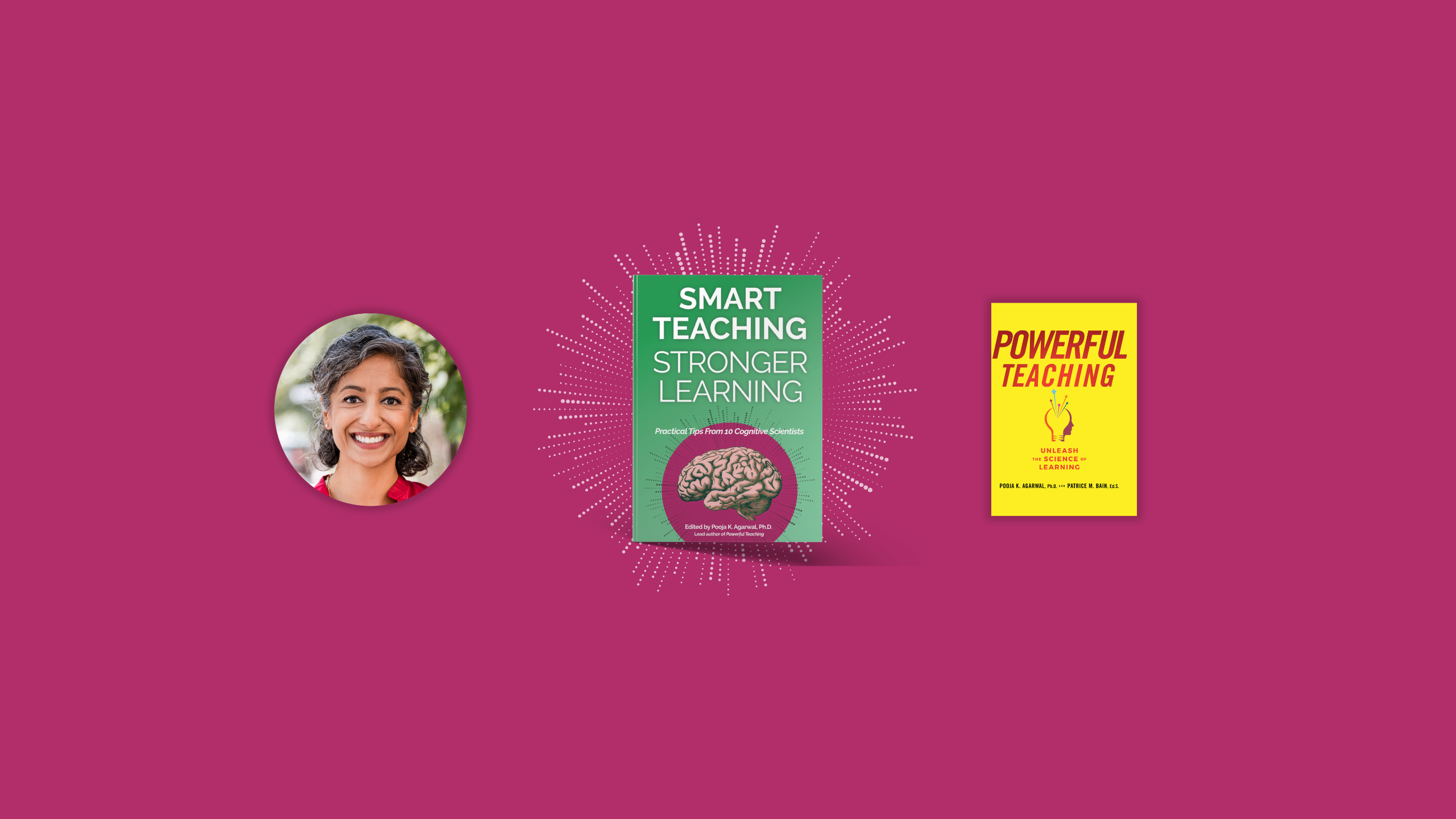
Thank you for unleashing learning at the ADE Summit!
Presented by Pooja K. Agarwal, Ph.D.
Cognitive Scientist & Associate Professor
Author of Powerful Teaching and
Smart Teaching Stronger Learning
ask@retrievalpractice.org

How can we support students during exam time and reduce test anxiety? Learn more about my research on student test anxiety and get quick lesson ideas to reduce anxiety with retrieval practice. It might sound counterintuitive, but the more students practice retrieval, the more comfortable they become with high-stakes tests.

Retrieval practice doesn’t require more class prep for us or ChatGPT for our students. Here are 8 no-prep prompts for retrieval practice I’ve developed over my 10+ years of teaching. I’ve also included a variety of new resources I highly recommend.

Here's a list of 40 cognitive scientists you need to know. They publish the newest research on retrieval practice, actively engage in science communication with educators on Twitter, and demonstrate diversity beyond the traditional ivory tower. Follow them, cite them, interview them, and reach out to them.

The world has changed and teaching has changed. One thing hasn't changed: The importance of learning and the frustration of forgetting. Here are 5 new resources and downloads, all free, all by cognitive scientists, all to empower you to unleash the science of learning.

Want a quick way to access classroom research on retrieval practice? Download our database of 50 experiments and read a detailed literature review by cognitive scientists.

Lots of students use flashcards. But using flashcards doesn't guarantee they're using retrieval practice. In fact, students could be wasting their time. This week, we share three research-based tips to make flashcards more powerful. Help students study smarter, not harder.

Whether you teach at an elementary school or a medical school, you've probably heard of the instructional strategy, think-pair-share. Don’t skip the “think” step! Read on for research-based tips on incorporating retrieval, spacing, and interleaving to make think-pair-share an even more powerful strategy in your classroom.

How can we use retrieval practice to break up our lessons, quickly and easily, without pausing to facilitate class discussion or collect papers? Use a retrieval strategy we simply call "Two Things," a no-quiz activity for your classroom.

With the end of the semester within sight, we feature a small strategy that makes a big impact on student learning – based on decades of cognitive science research. In scientific lingo, we call it "free recall."
Read my new book, Smart Teaching Stronger Learning. Whether you teach K–12 students or graduate students, or you’re new to teaching or a long-time educator: If you want to improve student learning, this book is for you.